Workflow Automation
From Manual Work to Smart Work: The Power of Digital Transformation
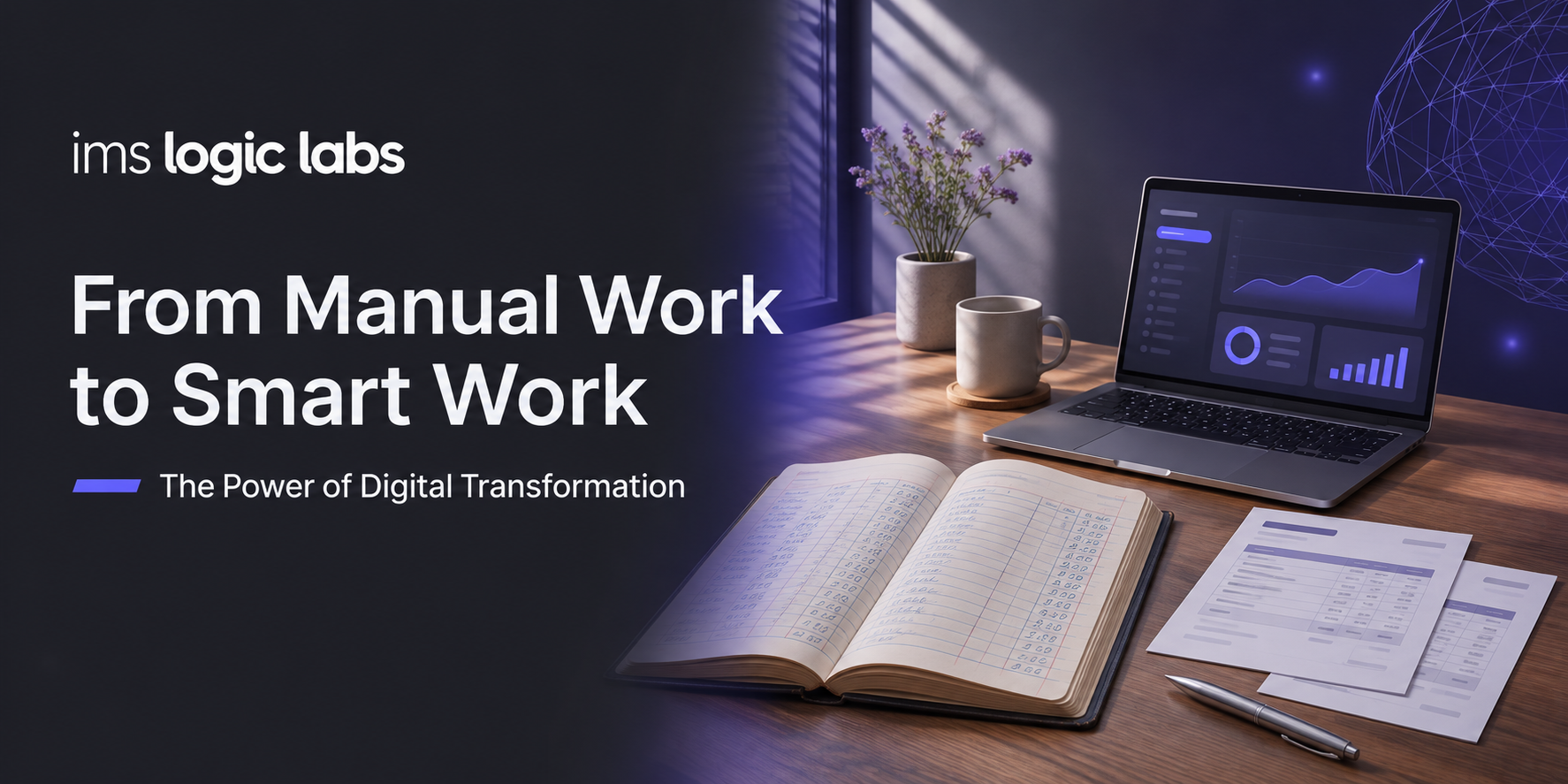
From Manual Work to Smart Work: The Power of Digital Transformation
By IMS Logic Labs
Introduction
Running a business is not just about selling products or providing services. It also involves managing customers, employees, records, payments and many other daily activities. When all these tasks are handled manually, they can take a lot of time and sometimes become difficult to manage.
Many small and medium-sized businesses still use paper records, Excel sheets and separate tools to manage their work. These methods may be useful in the beginning, but as a business grows, managing everything manually becomes more challenging.
This is where digital transformation becomes important.
Digital transformation simply means using technology to make business activities easier and more organized. It can include websites, mobile applications, custom software, AI and automation.
The purpose is not to replace traditional business methods completely. It is to find better ways to complete everyday tasks, reduce unnecessary work and improve business performance.
Why Are Businesses Moving from Manual Work to Digital Solutions?
Imagine a business owner who manages customer details in notebooks, prepares invoices manually and checks stock by visiting the storage area.
Every day, the same activities need to be repeated. If an order is missed or information is entered incorrectly, it can create problems for both the business and its customers.
Now imagine using a digital system where customer details, invoices, orders and inventory are available in one place.
The owner can check the required information without searching through multiple files. Employees can also access the information they need and complete their work more easily.
This is one of the main reasons businesses are moving towards digital solutions.
Technology helps businesses manage their daily operations in a more organized way and gives employees more time to focus on important work.
How AI and Automation Make Business Work Easier
Artificial Intelligence (AI) and automation are becoming useful parts of modern business operations.
Many businesses spend a lot of time on repetitive activities such as sending emails, updating records, preparing reports and following up with customers.
With automation, some of these tasks can be completed automatically.
For example, when a customer submits an enquiry through a website, the system can automatically send a confirmation email and notify the sales team.
Similarly, businesses can use automation for payment reminders, appointment confirmations, invoice generation and customer follow-ups.
AI can also help businesses analyses information, answer common customer questions and support decision-making.
The main benefit is that employees do not have to spend all their time on repetitive activities. They can focus more on customer service, planning and business development.
A Real-World Example: How Maruti Suzuki Uses Digital Technology
Digital transformation is not limited to IT companies. It is also changing traditional industries such as automobile manufacturing.
Maruti Suzuki India Limited is a good example of how a large Indian automobile manufacturer uses technology to improve its operations.
Vehicle manufacturing involves several stages, including assembling parts, checking product quality, monitoring machines and managing production activities. Handling these processes requires proper coordination and accuracy.
According to Maruti Suzuki's Annual Integrated Report 2024–25, the company uses digital technologies such as real-time equipment monitoring, digital maintenance systems and machine-vision-based inspection systems.
These technologies help the company monitor manufacturing operations, identify quality issues and improve production processes. The company also uses digital dashboards to monitor performance and support better decision-making.
Maruti Suzuki has also adopted Industry 4.0 and Industry 5.0 approaches to improve manufacturing capabilities.
This example shows that technology is not only about having advanced machines. It is also about using information, automation and digital systems to improve everyday work.
It gives an important lesson to smaller businesses too: even simple digital improvements can make daily operations easier and more organized.
4 Practical Use Cases of Digital Transformation
Digital transformation is useful in almost every industry. The technology may be different, but the purpose remains the same: solving business problems and making work easier.
1. Retail and E-commerce Businesses
Retail businesses need to manage products, customer details, orders and payments every day.
When everything is managed manually, it becomes difficult to track sales and maintain accurate stock records.
How technology can help:
Automatic stock updates after every sale.
Digital billing and invoice generation.
Online product catalogues.
Customer order tracking.
With a proper digital system, business owners can manage their products and sales more easily.
2. Hospitals and Healthcare Centers
Hospitals manage a large number of patients, appointments and medical records. Managing all this information manually can create delays and additional work for staff.
How technology can help:
Online appointment booking.
Digital patient records.
Appointment reminders.
Doctor and staff scheduling.
These solutions can help hospitals organize administrative activities and provide a smoother experience for patients.
3. Manufacturing Businesses
Manufacturing companies need to manage production, inventory, employees and delivery schedules. Even a small mistake in these activities can affect the overall process.
How technology can help:
Real-time inventory tracking.
Production monitoring.
Employee attendance management.
Automated production reports.
Digital systems can help manufacturers monitor their operations and manage resources more efficiently.
4. Service-Based Businesses
Service-based companies regularly receive customer enquiries, schedule appointments and follow up with potential customers.
When these activities are handled manually, some enquiries may be missed or responses may get delayed.
How technology can help:
Customer relationship management (CRM).
Automated enquiry responses.
Appointment scheduling.
Customer follow-up notifications.
These solutions help businesses maintain better communication with customers and manage their daily activities more effectively.
The Importance of Websites, Mobile Applications and Custom Software
Every business has different requirements. A solution that works for one company may not be suitable for another.
A professional website helps a business build its online presence, showcase its services and connect with potential customers.
Mobile applications make it easier for customers and employees to access services and information through their smartphones.
Custom software is useful when a business needs a solution designed around its specific requirements. For example, a company may need a single system to manage employees, customer information, inventory and reports.
Choosing the right digital solution can help businesses reduce unnecessary manual work and improve the way different activities are managed.
How IMS Logic Labs Helps Businesses Move Towards Digital Transformation
At IMS Logic Labs, we understand that every business has different goals and challenges. Some businesses need a professional website, while others require custom software or automation to manage their daily operations.
Our focus is on understanding business requirements and providing practical digital solutions.
Our services include:
AI and Automation: Helping businesses simplify repetitive activities and improve their workflows through smart automation.
Web Development: Creating professional and user-friendly websites that help businesses build a strong online presence.
Custom Software Solutions: Developing software according to specific business requirements to make daily operations more organised.
Mobile App Development: Building mobile applications that make business services and information easier to access.
We believe technology should make work easier, not more complicated. The right digital solution should help businesses save time, improve their processes and focus on growth.
Conclusion: Start Small, Think Big
Digital transformation does not happen overnight. Businesses do not need to change every process at once or invest in every new technology.
They can start with small improvements, such as moving from paper records to digital records, introducing online appointment booking or automating customer follow-ups.
The important thing is to understand which activities are taking too much time and find a better way to manage them.
As technology continues to develop, businesses have more opportunities to improve their operations and serve their customers better.
Moving from manual work to smart work is not just about adopting new technology. It is about finding smarter ways to work, solving everyday problems and preparing for future growth.
At IMS Logic Labs, we aim to turn business challenges into practical digital solutions.
IMS Logic Labs – Technology That Makes Work Easier.
Website: https://imslogic.com/
References
Maruti Suzuki India Limited – Annual Integrated Report 2024–25
Maruti Suzuki – Official Company Website